One week. Every correct answer counts for your school.
The Divisible Dash Cup is an inter-school competition scored on the game's Daily Challenge. Students play a short run a day, in the free app on their own phone or logged in on a school laptop, at school or at home, and every right answer is a point for your school. Nothing to install on school machines, nothing for teachers to run during the week, and no student data to hand over. It is run by a serving maths teacher.
- Free to enter, and the full game free for every student during the cup
- Nothing to run: students play, the board fills itself
- No student accounts and no student names: every player is a picked name
Opens in
Sign up with your school email, create your classes with their year groups, and your school is in. Nothing to pay and nothing to cancel. Interested sends me one email and you hear the dates first.
Who is in
The schools entered so far.
Schools are listed as they enrol. Any school, any year group: the ranking is per student, so a small school competes with a large one.
How the cup is scored
Four rules, and they fit in one sentence to a class: every correct answer in every Daily Challenge is a point for your school, and schools are ranked per student.
- Play the Daily ChallengeThe same run for every player in the world that day. Up to three a day, one per tier, each a minute or two.
- Every correct answer is a pointEvery tier counts the same, at school or at home. Playing up the tiers is the way to more points.
- Ranked per studentCorrect answers divided by the students who played, so turning the whole class out is what wins. A class of ten competes with a class of thirty.
- Cup points by placingEach year group is its own ranking and gives cup points by placing, 10, 8, 6, 5, 4, 3, 2, 1, once three or more schools have placed in it. Most cup points across the year groups takes the cup.
What is ranked
- The cup. Schools, by cup points.
- Each year group. Schools, by correct answers per student.
- Best class. The classes in each year group.
- Best player. The top students in each year group, by picked name.
- Daily winners. The class and the student of each day.
- The rule the cup got wrong most. Your next lesson, at the close.
Ranks and scores are worked out on the server every fifteen minutes from the Daily scores the game already keeps. The page prints what it is sent, and nobody at a school can touch a figure.
The podium on the cup page, with a medal for each step and a trophy for the cup.
What the week looks like
Five school days, and the week before to get ready. Each cup day is a whole day in UTC, so in Bangkok it runs from 7am to 7am.
Warm up
Every class plays one Daily in a lesson, so every join is sorted before it matters. The full game switches on for every student in the school.
Cup week
Students play their Dailies, any tier, in a lesson, on a laptop or at home. Three a day is everyone's ceiling, so the way up is Intermediate and Advanced. The live page on the projector shows the podium, each year group and your school's run, with a daily winner by each afternoon. Teachers watch.
Results
Late scores from offline phones count for two more days, then the standings are final: the year group winners and the cup. The rule the whole cup got wrong most is your next lesson.
Class rounds in lessons carry on as normal; they are practice and score nothing in the cup.
The page you put on the projector
Schools, the best classes and the top players of each year group, updated every fifteen minutes. Students appear as their picked names only and teachers are never named. It needs no login and works on a projector, a laptop or a phone. Below is the demo cup, with invented schools.
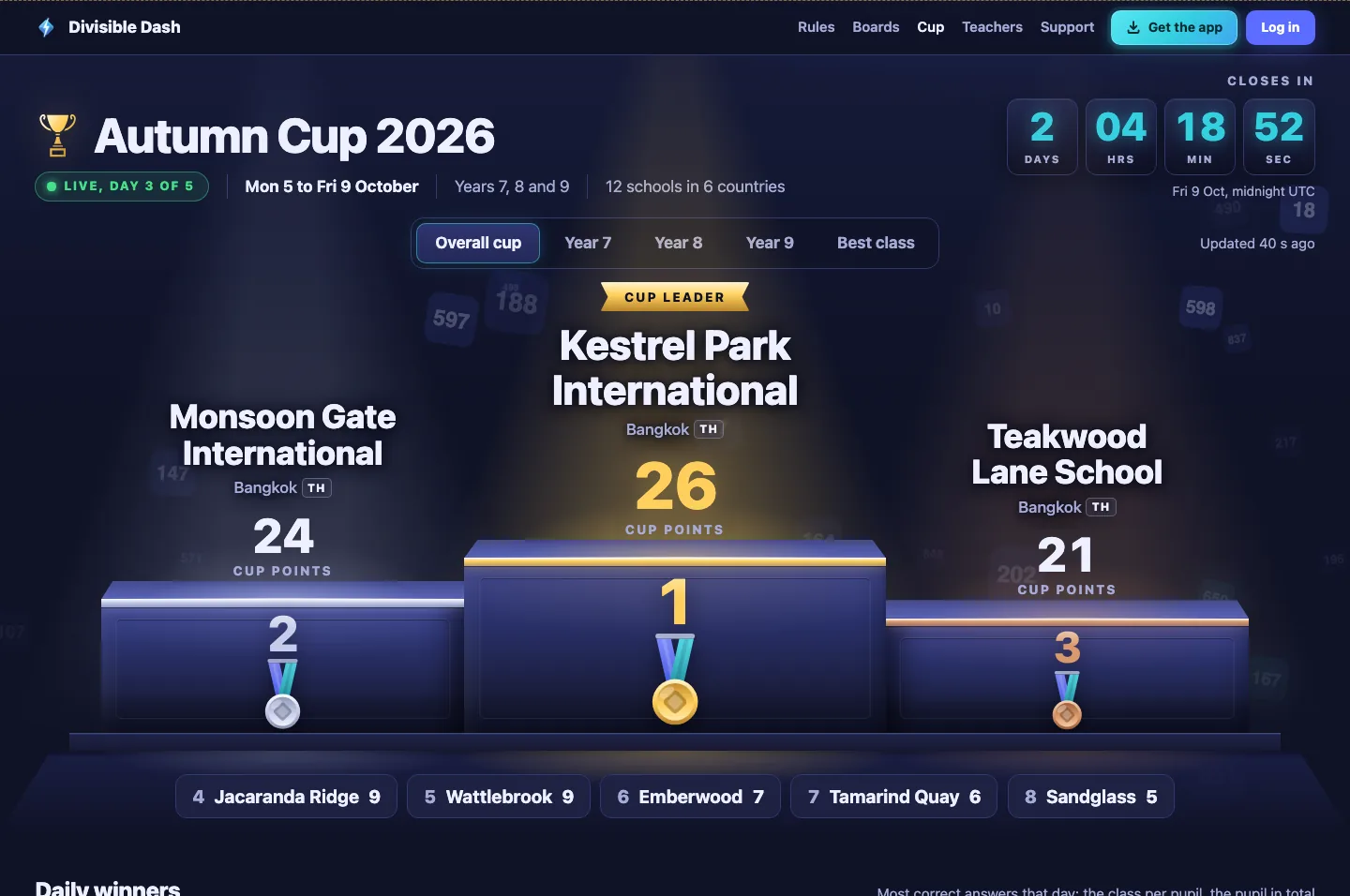
The live page: divisibledash.com/cup
How your school enters
Signing up is entering. There is no form, no procurement, no IT ticket and no student data to hand over.
-
Ten minutes, once
Each teacher creates a free account
At divisibledash.com/teachers, with a school email address or a school Google account. The first teacher names the school; colleagues pick it from the list. A school address is what puts a class under your school's name.
-
Two minutes a class
Create a class and set its year group
Each class gets a six-character code and a printable code sheet for the wall. The year group is a select on the class page; a class with students from two year groups goes under the higher one.
-
One lesson
Students join with the code
Students install the free app, tap JOIN CLASS and type the six characters. That is the whole join. No student accounts, no student emails, no consent forms to chase.
-
Nothing to send
Your school is in
Every class at your school with a year group set is entered when your school's name is approved, which happens for every new school. A class without a year group sits the cup out. If you would rather I set the classes up, one email does it.
-
The week before
Everyone plays one Daily in a lesson
Five minutes. Your class board shows who landed, so a student who typed the wrong code is found a week before it matters.
-
Cup week
Watch
Students play their Dailies. The live page on the projector, your class boards on the dashboard, and the rule the room keeps getting wrong named for you at the close.

The data question, answered first
Your students never type a personal detail into this game, because there is nowhere in it to type one. A cup adds nothing new about a student: the standings are worked out from the Daily scores the game already keeps.
Never collected, by design
- No student names. Every player is a picked name such as SwiftFalcon42, assembled from curated word lists.
- No student email addresses. A student has no account to create and no password to forget. The class code is the entire join.
- No age, date of birth or location. A student's year group is a property of the class, set by the teacher.
- No chat, no messaging, no adverts and no third-party tracking or analytics SDKs.
What a cup shows
- Your school's name, as you approve it, beside its scores in each year group.
- Classes as a short code you choose, such as 8B. Never the teacher's own class name, and teachers are never named anywhere on the cup.
- The top students by picked name, with their school, in the best player table for their year group.
- Nothing else. Your school's class-by-class lines are not on the public page.
The paperwork exists and is linked, not promised. Privacy policy, Teacher Terms and a schools data-processing agreement your data protection lead can read today. Where a roster of first names exists on your dashboard, your school is the data controller and the terms say so in plain words.
What it costs
Nothing. Entering is free, the dashboard is free, and for the two weeks of the cup every student in an entered school has the full game free.
| What | Cost | Notes |
|---|---|---|
| Entering the cup | Free | Any number of classes, any year groups. No licence, no invoice, nothing to cancel. |
| Teacher dashboard, class codes and class boards | Free | Unlimited classes and students, per-rule accuracy, CSV export, a board in any browser at divisibledash.com/class. |
| The Daily Challenge, for every student | Free | Every day, forever, the same numbers worldwide, plus two practice runs a day. This is what the cup is scored on. |
| The full game during the cup | Free for every student | Unlimited practice and Drill Mode for every student in an entered school, for the warm-up week and the cup week. It lapses on its own afterwards. |
| The full game all year | Free for founding schools | Schools joining this school year keep the full game for every student until 31 July 2027. |
Otherwise the full game is one optional unlock an individual buys once, GBP 4.99, never a school and never a subscription. There are no adverts anywhere in the game, and nothing a player can be charged for repeatedly.
The questions a head of department asks
Our students are not allowed phones in school.
Two routes, and both count. One: students play in a browser on a school laptop or Chromebook, logged in with the web login code the app gives them (Profile, then Web login), so a lesson needs no phone at all. Two: the Daily is one short run a day, so it works as homework on their own phone or tablet. Either way the board fills, and the live page on the projector is the only thing that needs a screen in the room.
We have small classes, or only one class.
Classes and schools are ranked by correct answers per student, so a class of ten competes with a class of thirty. The divisor has a floor of eight, which means a class of five is handicapped a little, not excluded. One class is enough once other schools have a class in that year group: it has a year group table, a best class table and a best player table to climb.
Which tier should a class play?
Any, and every correct answer counts the same. Beginner is 2, 3, 5 and 10; Intermediate adds 4, 6, 8 and 9; Advanced is all of them, including 7. A student can play all three in a day, and the way to more points is up the tiers, so a Year 7 class learning the 8 rule and a Year 10 class drilling 7 are both playing the game they should be.
Can one student carry a school, or cheat?
The Daily is one attempt per tier per day and the same run for everyone, so there is nothing to grind. There is a ceiling on what one account can add in a day, and a run that is not a possible run is left out. A school is won by turning the whole class out, which is the behaviour the cup is built to reward.
What time does each cup day start and end?
Each cup day is a whole day in UTC, the same day the Daily Challenge uses everywhere. In Bangkok the first day opens at 7am on the Monday and the last day closes at 7am on the Saturday. In the UK it is midnight to midnight in winter time and 1am to 1am in summer time.
A class has students from two year groups.
Enter it under the higher year group. Every class in the cup is listed by its teacher under one year, and the list is checked by a person, not a form.
What does the department have to do during the week?
Nothing. There is no round to start, no setting to change and no score to submit. Students play their Dailies and the standings are worked out on the server every fifteen minutes. Class rounds in lessons carry on as normal and score nothing in the cup.
Who can see the results?
Anyone with the link to the cup page sees schools, the best classes and the top players of each year group, by picked name. Your own classes' boards, with the roster of first names if you typed one, are on your teacher dashboard and visible to you alone.
Sign up, set your year groups, and your school is in
Each teacher creates a free account with a school email, makes their classes and picks a year group for each. That is the entry. Not ready to sign up? Interested sends me one email and you hear the dates first; if you would rather I set the classes up, say so in it and I will do it in ten minutes.
No call to book, no demo to sit through, no sales follow-up. Questions go to the maths teacher who runs the cup.